
How to calculate drapery yardage: a worked example
Follow one drapery pair from finished coverage to a fabric order, and see why a straight pattern repeat changes the cut length.
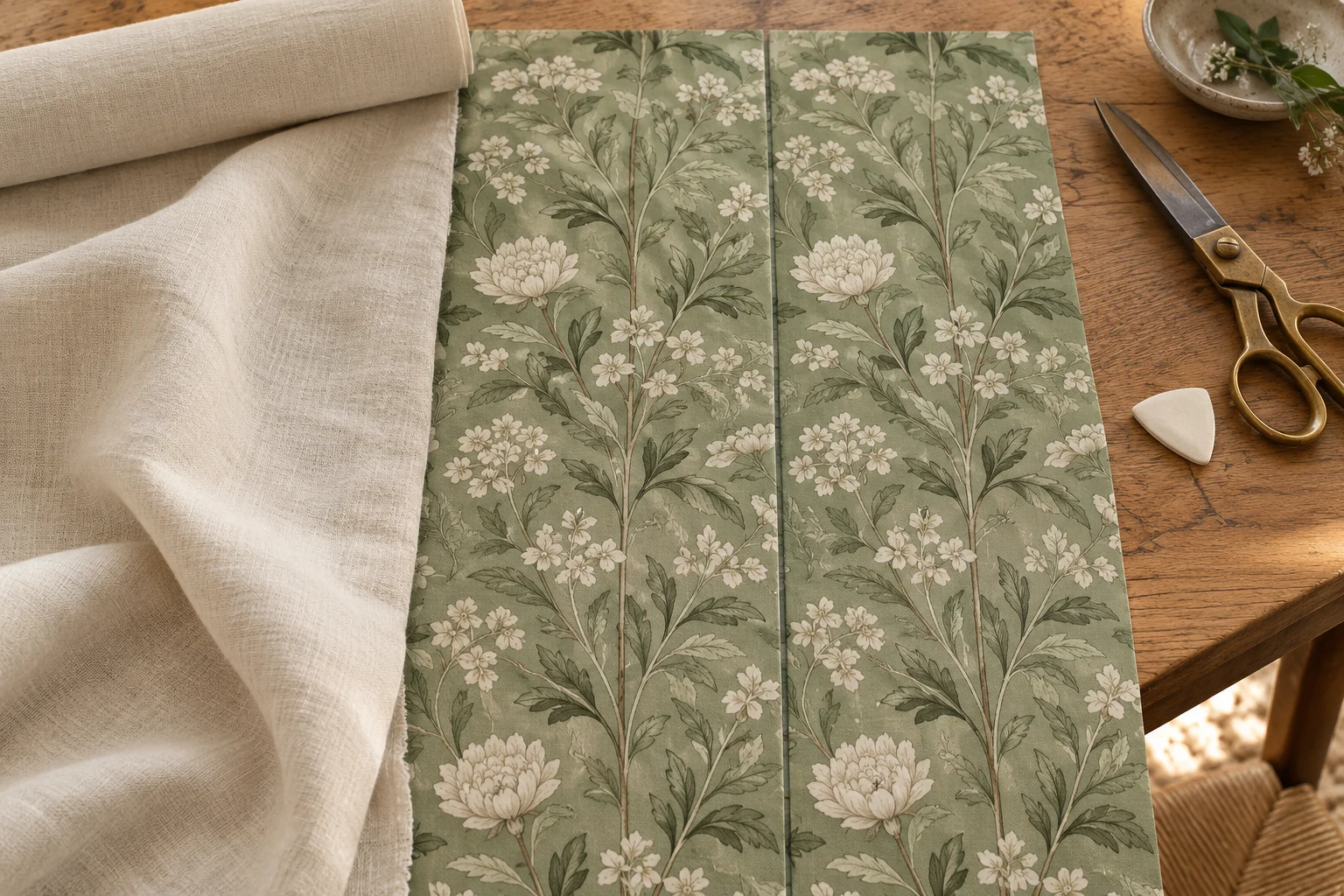
The quickest way to understand a yardage estimate is to follow the cuts behind it. In this example, a pair of rectangular drapery panels needs 12 yards of solid face fabric. A 24-inch straight vertical repeat changes the order to 13.5 yards, even though the finished treatment stays the same size.
These figures follow the Workroom Tools calculator and its full-width cutting method. The allowances are example settings, not a construction standard for every workroom.
Start with finished coverage and drop
Coverage is the span the finished drapery body must cover along the rod. It is not automatically the same as the window opening, and it excludes the separately entered flat returns and center overlap in this tool.
The example uses:
- 72 inches of total finished coverage and a 96-inch finished drop.
- Two equal panels at 2.5× fullness.
- A 3-inch flat return and 2-inch flat overlap on each panel.
- 54 inches of usable fabric width, excluding unusable selvages.
- 3 inches consumed by each side hem and ½ inch from each edge of a join.
- 4 inches of top allowance and 8 inches of bottom allowance.
Extra worktable length, start allowance and purchase reserve are all zero for this comparison.
Find the fabric width for each panel
First calculate the flat body width: 72 × 2.5 ÷ 2 = 90 inches per panel. Then add the flat edge zones: 90 + 3 + 2 = 95 inches.
Two side hems consume another 6 inches, so the required joined width before hemming is 101 inches. A single 54-inch width is too narrow.
Two full widths start at 108 inches. The joining seam consumes ½ inch from each edge, leaving 107 inches after joining. That covers the 101-inch target and leaves 6 inches to trim per panel before the side hems are made.
The pair therefore needs four full-width cuts: two for the left panel and two for the right. The calculator shows this excess width rather than treating all of it as finished fullness. It does not split one width between panels or optimize fractional widths.
Turn the finished drop into a cut length
For solid cloth, add the allowances to the finished drop:
96-inch drop + 4-inch top + 8-inch bottom = 108-inch cut length.
Four cuts at 108 inches require 432 inches along the roll. Dividing by 36 gives 12 yards. With no additional reserve, quarter-yard rounding leaves that order unchanged.
For a double-fold hem, enter all the cloth the folds consume. For example, two 4-inch folds use an 8-inch allowance; entering only 4 would understate the cut length.
Add a straight vertical repeat
With a 24-inch repeat, a 108-inch base cut falls between complete repeats. The calculator rounds up to five repeats: 5 × 24 = 120 inches per cut.
Across four cuts, that becomes 480 inches, or 13⅓ yards before purchase rounding. Rounding upward to quarter yards gives a 13.5-yard order.
| For the same pair | Solid | 24-inch repeat |
|---|---|---|
| Full-width cuts | 4 | 4 |
| Length per cut | 108 in | 120 in |
| Length before rounding | 12 yd | 13⅓ yd |
| Quarter-yard order | 12 yd | 13.5 yd |
The photograph illustrates aligned patterned lengths; it is not a measured sample of a 24-inch repeat. Inspect the actual fabric and the supplier’s repeat information.
Keep motif placement and reserve separate
Whole-repeat rounding does not decide where the first motif should sit. The start allowance reserves extra cloth at the beginning of the face-fabric order. Purchase reserve is a separate length added once after the cuts have been counted.
For this repeat example, adding a 24-inch start allowance and 36-inch reserve changes the total to 480 + 24 + 36 = 540 inches, or 15 yards. Neither allowance is multiplied by the cut count.
Half-drop patterns, horizontal matching, railroaded layouts and motif centering are outside this calculator’s current method. Those projects need their own cutting plan.
Check the plan before you cut
- Confirm the finished coverage, drop and flat edge zones against the work order.
- Check usable cloth width and repeat on the material you will use.
- Review every seam and trim position against the pattern.
- Calculate lining separately using its own fabric width, shortening and hems.
- Export a project backup and print the cut list after reviewing the allowances.
The calculator’s diagram is schematic. Use its dimensions and cut list alongside your workroom methods; it is not a full-size pattern. You can read the complete calculation method and limits before entering a new job.
Why another estimate may give a different answer
Before comparing totals, check whether both methods use the same coverage and the same definition of a panel. In this example, 72 inches is the coverage of the whole pair, not the width assigned to each side. Fullness creates 180 inches of flat body fabric in total, divided into two 90-inch bodies before their edge zones are added. Entering 72 inches for each panel would describe a different treatment.
Next compare how each method handles partial widths. This calculator assigns whole widths to each panel independently. A workroom cutting plan that divides one width between two panels may use less fabric, but it also changes seam positions and the available width at each edge. The difference needs a construction decision, not an arbitrary subtraction from the order quantity.
Finally, keep the same order increment. The repeat calculation produces 13⅓ yards before purchasing rounding. A supplier order in quarter-yard increments becomes 13.5 yards; a whole-yard increment becomes 14 yards. That difference is purchasing round-up, not another fabric cut. Ask the supplier about the increment and continuous lengths available for the actual material before finalizing the order.
Questions about this curtain fabric calculation
How many yards do I need for two 96-inch curtains?
Finished length alone is not enough to answer. You also need coverage, fullness, usable width and construction allowances. The specific pair in this article needs 12 yards of solid face fabric because it has four cuts at 108 inches. A narrower pair that needs fewer widths, or cloth with a pattern repeat, can produce a different total even with the same finished length.
Does the 12-yard example include lining?
No. It is the face-fabric order only. Calculate lining independently using its usable width, shortening, seams and hems. The face material and lining may have different cut counts or cut lengths. Keep their quantities labeled separately when preparing the order, and check that the lining construction fits the calculator’s stated method.
Do I add a full repeat to every cut?
This calculator rounds the base cut upward to the next complete vertical repeat. It does not automatically add a whole extra repeat to a cut that already ends on an exact repeat boundary. The starting position of the first motif is a separate allowance. These rules are specific to its straight-match method; they do not solve half-drop matching or motif centering.
Can I use the result for pinch pleat curtains?
You can estimate the cloth when your rectangular panel construction matches the method and you supply the correct fullness and allowances for your heading. The result does not calculate the number, depth or spacing of the pleats. Resolve that heading layout separately, including how returns, overlap and seam positions will be handled.
Further reading and the next step
For a workroom discussion of cut length and repeat arithmetic, see Workroom Tech’s calculating-yardage lesson. The OnlineFabricStore drapery calculator is another supplier reference for measurement terminology. Their construction conventions may differ from the explicit rules used here.
To apply this example, open the drapery yardage calculator, review the input guide and enter your own work order. Keep the calculation, fabric details and checked cutting list together before moving to the table.